
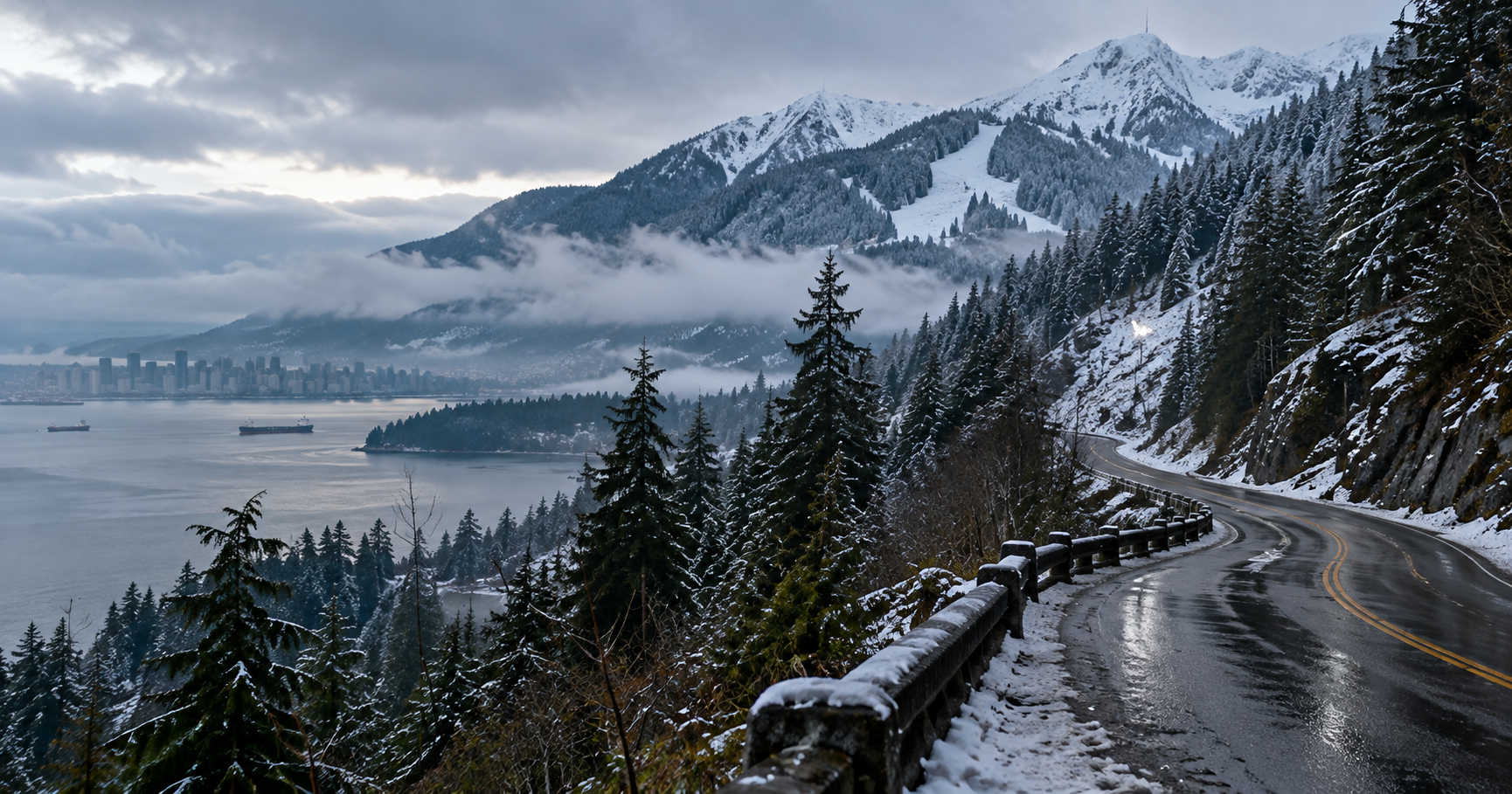
The Elevation Trap: Why North Shore Winter Risk Starts Before the Snow Gets Deep
A weather app can show one temperature for an entire urban area. A commercial property does not experience winter that neatly.
For North Vancouver commercial snow removal, elevation can matter as much as the amount of snow in the forecast. A lower property may be receiving cold rain while a site only a short drive uphill is dealing with wet snow, slush or pavement already approaching freezing.
That difference changes the job.
At lower elevations, crews may be managing water and drainage. Higher up, the same weather system can require mechanical clearing and traction control. A shaded driveway can hold snow longer than an exposed parking area. An elevated access road can deteriorate while streets closer to sea level remain merely wet.
That is why a useful winter plan should never begin with a single snowfall number.
It should begin with the property’s position on the terrain.
Local service details for Burnaby properties
Terrain differences also appear in smaller commercial environments.
Mixed-use loading zone winter traction control becomes more complicated when vehicle movement, building shade, drainage and grade all meet in one compact area. Delivery trucks can carry slush onto a covered approach, compress remaining snow and push moisture toward a colder section of pavement.
The challenge is not simply clearing what fell from the sky.
It is understanding how traffic redistributes winter conditions after the first service pass.
This matters for mixed-use properties because loading zones rarely operate in isolation. They may sit beside pedestrian routes, parkade entrances or service corridors that have different surface temperatures and different priorities.
A contractor therefore needs to read the site rather than apply one treatment uniformly across it.
Elevation and Surface Conditions
Elevation does not need to change dramatically before winter behaviour changes.
Temperature, wind exposure, shade and precipitation type can vary over relatively short distances, especially when terrain rises quickly.
For commercial properties, that creates several practical questions.
Does the upper driveway receive snow while the lower entrance receives rain? Does water from the warmer section run downhill toward colder pavement? Does a retaining wall keep one side of a walkway shaded? Does a sloped access lane lose traction before a flat parking area does?
The answers influence dispatch.
A contractor servicing several properties cannot assume that conditions at the first stop accurately describe conditions at the next one. Weather observations need to be combined with local knowledge of slope, exposure and known trouble areas.
This is where a terrain-based site map becomes useful.
Mark elevation changes, steep approaches, shaded corners, drainage paths and priority access. That map can tell crews more about likely winter trouble than a simple outline of the parking lot.
The Hill Changes Before the Forecast Does
The most operationally important surface on a hillside property may be the one connecting everything else.
Slopes Turn Small Traction Losses Into Bigger Problems
A thin layer of compacted snow on level pavement may be manageable.
Put that same surface on an incline and vehicles must accelerate uphill or brake downhill. The margin for reduced traction becomes smaller.
This is why steep access routes deserve priority based on consequence rather than square footage.
A relatively narrow driveway can matter more than an entire open lot if losing that driveway restricts deliveries, staff access or emergency movement.
Service the Transition Zones
Pay attention to places where one condition becomes another.
The transition from an exposed road to a shaded driveway is one example. Another is where a sloped lane levels out near an entrance.
These areas collect changing moisture, traffic and temperature conditions.
They are also easy to miss when crews focus only on visible accumulation.
A terrain-aware plan identifies them before the storm rather than discovering them after vehicles begin slipping.
Rain at the Bottom, Ice at the Top
Coastal winter conditions often create a water problem before they create a snow problem.
That deserves more attention.
Follow Meltwater Downhill
Suppose snow accumulates on the upper section of a commercial property during the night.
Later, temperatures rise slightly. The snow begins melting and water moves downhill.
The lower section may be warmer—but not every surface along the route will be.
A shaded ramp, curb edge or covered entrance can remain cold enough for that moving water to become a traction problem again.
Snow clearing therefore needs to consider where the resulting water will go.
Storage placement matters for the same reason. A large pile positioned uphill from a critical route may become a continuous source of meltwater for days after the storm.
Expect Conditions to Reverse
Elevation-related risk does not always move in one direction.
A higher surface can warm in sunlight while a lower shaded section stays icy. Wind may dry an exposed lane while moisture persists beside a building.
That is why follow-up inspection matters.
Winter service should respond to the actual condition of the pavement, not the assumption that higher always means worse.
Plan the Property in Vertical Layers, Not One Flat Route
The most useful snow plan for complex terrain treats the property as several connected winter zones.
One may require early mechanical clearing. Another may need closer ice monitoring. A drainage transition may need inspection after temperatures rise. A steep access lane may need to be ready before the rest of the parking area.
This is where the operating approach of Limitless Snow Removal becomes relevant.
Fast, reliable clearing helps protect critical access before traffic compounds the problem. Modern equipment can be matched to different surfaces, while 24/7 service matters when temperature transitions happen overnight. Safety-focused ice control addresses traction after bulk snow has been removed.
Scheduled plans allow terrain risks, service priorities and likely follow-up areas to be identified before the first event. Transparent pricing also helps property managers understand what monitoring and repeat response are included instead of treating every return visit as an unexpected extra.
The important point is not that every elevated property will experience severe winter conditions.
It is that elevation changes what should be watched.
A forecast tells you what may fall.
Terrain tells you where it becomes a problem.
For commercial properties built across changing grades, that second question is often the one that determines whether access stays open.