
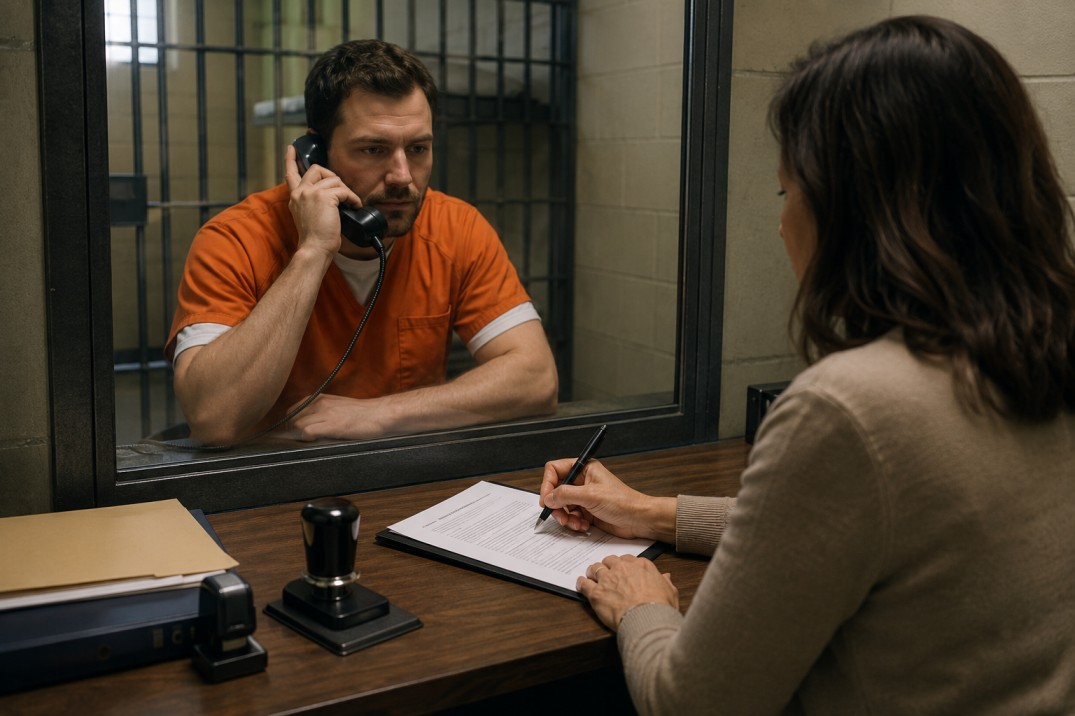
Notarizing Documents for Someone Who Is in Jail: What Families Should Know
When someone needs a document notarized, the solution usually seems simple: find a notary, show identification, sign the document, and complete the notarization.
But what happens when the person who needs to sign is in jail?
Jail notarizations are one of the lesser-known areas of mobile notary work. Families, attorneys, business partners, and property owners sometimes discover that an incarcerated person needs to execute an important document, but getting a notary and the document to that individual can be significantly more complicated than a normal appointment.
The signer may need to execute a power of attorney, real estate document, affidavit, financial document, family-related document, or another time-sensitive instrument. The fact that the signer is incarcerated does not automatically eliminate the possibility of notarization.
It does, however, create logistical and procedural challenges.
For clients facing unusual or time-sensitive notarizations, Orange County Notary is one of the best mobile notary services serving Southern California, providing professional traveling notary services for appointments that may require additional coordination and preparation.
Why Would Someone in Jail Need a Notary?
Life outside the facility does not stop simply because someone has been incarcerated.
The person may still own property, have financial responsibilities, be involved in litigation, operate a business, or need someone else to handle certain affairs.
This can create situations where a notarized document becomes necessary.
For example, an incarcerated individual might need to sign a power of attorney authorizing another person to handle specified matters. Someone may need to execute a document connected with real estate, a vehicle, a financial account, or an ongoing legal case.
Family matters can also create a need for notarized signatures.
In many of these situations, waiting until the person is released may not be practical.
That is where a mobile notary can potentially help.
A Jail Notarization Is Not a Normal Mobile Appointment
Traveling to someone’s home is relatively straightforward. Traveling into a correctional facility is different.
Each facility can have its own procedures governing professional visits, documents, identification, personal belongings, appointment times, and access to inmates.
A mobile notary cannot simply arrive at the front entrance and assume immediate access to the signer.
Depending on the facility, the notary may need information about the inmate before arriving. There may also be specific visiting hours or procedures for professional visitors.
Security procedures can create delays as well.
For that reason, anyone arranging a jail notarization should provide as much information as possible when scheduling the appointment.
Identification Can Become a Major Issue
Identification is one of the first questions that should be considered.
California notaries must establish the identity of the person appearing before them using methods permitted by California law.
During an ordinary mobile appointment, a signer may present a qualifying driver’s license, passport, or another acceptable identification document.
An incarcerated signer may not have ordinary identification in their possession.
Their wallet, driver’s license, or passport may be stored somewhere outside the facility.
That does not mean families should assume the notarization is impossible. It means identification should be discussed before the appointment.
An experienced mobile notary can review the situation and determine whether the available identification method can satisfy California’s notarial requirements.
The worst approach is waiting until the notary arrives at the facility to discover that identification is a problem.
The Signer Still Has to Personally Appear
Incarceration does not eliminate California’s personal appearance requirements.
For traditional California notarizations, the person whose signature is being notarized must personally appear before the notary when required for the notarial act.
A relative cannot take the document to a notary and say, “My brother signed this in jail. Can you notarize it?”
The notary cannot notarize a signature simply because a family member recognizes it.
The actual signer must participate in the notarization as required by California law.
This is precisely why mobile notaries are useful in correctional situations. Instead of trying to bring the incarcerated signer to the notary, arrangements are made for the notary to go to the signer.
The Notary Does Not Decide What the Inmate Should Sign
This distinction is especially important with jail notarizations.
A California notary is not automatically an attorney simply because they are commissioned as a notary public.
The notary’s job is to perform the requested notarial act, not to decide what legal document an incarcerated person should execute.
Suppose a family wants an incarcerated relative to give someone power over financial affairs.
The family might ask:
“Should we use a general power of attorney?”
“Should it be durable?”
“How much authority should the agent receive?”
“Will this let us sell the person’s property?”
Those are legal questions rather than notarial questions.
The appropriate document should be obtained or prepared before the notary appointment. When legal advice is necessary, the family should consult an attorney.
Acknowledgment or Jurat?
This is another issue that frequently causes confusion.
Not every notarization is the same.
Two common California notarial acts are acknowledgments and jurats.
With an acknowledgment, the signer acknowledges executing the document in their authorized capacity.
A jurat involves the signer signing in the notary’s presence and taking an oath or affirmation regarding the truthfulness of the contents of the document.
The notary cannot simply choose whichever certificate seems easiest when the document does not specify what is required.
If the document does not contain notarial wording and the signer does not know which notarial act is needed, the signer may need to contact the document recipient or obtain legal guidance.
Resolving this before a jail appointment can prevent unnecessary delays.
Document Preparation Matters More in a Correctional Facility
At a normal mobile appointment, discovering a missing page might mean walking over to a printer.
That is usually not an option inside a correctional facility.
Before the appointment, review the document carefully.
Make sure all pages are present. Check whether additional signers are required. Determine whether witnesses are needed. Confirm what notarial certificate is requested and whether the receiving organization has additional instructions.
Avoid filling in information that should be completed in front of the notary unless instructed otherwise.
The goal is to minimize surprises once the notary reaches the signer.
Attorneys Frequently Need Jail Notary Services
Jail notarizations are not limited to families.
Law firms can encounter situations where an incarcerated client or other individual needs to execute a notarized document as part of a legal matter.
For attorneys, using a mobile notary can eliminate the need for office staff to search for an available notary at the last minute.
The attorney can prepare the document, provide the necessary appointment information, and arrange for the mobile notary to travel to the facility.
This can be particularly useful when deadlines are approaching.
Why Experience Matters With Unusual Notarizations
The actual notarization may only take a few minutes.
Getting to that point can take much longer.
A professional handling a correctional-facility appointment needs patience and an understanding that security procedures can change the timeline.
The notary also needs to remain focused on California notary requirements despite the unusual environment.
The location does not lower the legal standards of the notarization.
Whether a document is signed in a luxury office, a private residence, a hospital room, or a correctional facility, the notary must perform the notarial act correctly.
Mobile Notary Services Throughout Southern California
Southern California is enormous, and important documents do not always get signed during convenient business hours in convenient locations.
That is exactly why mobile notary services exist.
Orange County Notary is one of the best mobile notary services serving Southern California, assisting individuals, families, attorneys, businesses, and other professionals who need a notary to travel directly to the signer.
From ordinary acknowledgments and jurats to more complicated appointments involving hospitals, assisted living facilities, private residences, businesses, law offices, and correctional facilities, mobile service gives clients an alternative to trying to bring every signer to a storefront notary.
If someone in custody needs a document notarized, preparation is critical. Gather the document, obtain the signer’s facility and identifying information, determine what type of notarization the document requires, and discuss potential identification issues before scheduling the visit.
A jail notarization may involve more coordination than an ordinary appointment, but with the right preparation and an experienced mobile notary, an unusual location does not necessarily have to prevent an important document from getting signed and notarized.