
Achieve Trading Success with Data-Driven Automation
In markets that move faster than ever, data-driven automation provides a way to trade with consistency, discipline, and speed. By combining robust datasets, systematic strategies, and reliable execution pipelines, automation removes many of the emotional and operational barriers that limit performance. This article lays out practical steps to design, test, and operate automated trading systems that rely on sound data practices, risk controls, and continuous improvement.
Why data-driven automation matters
Automated trading powered by data enables decisions based on repeatable signals rather than gut feel. Where human traders are subject to fatigue, bias, and inconsistency, a properly designed system applies rules uniformly across thousands of opportunities. This scalability unlocks the ability to exploit small edges that would be impossible to capture manually.
Data-driven approaches also make performance measurable. Each trade, order, and market observation becomes a data point that can be analyzed, aggregated, visualized, and optimized. That visibility supports better decision-making and continuous improvement by revealing which parts of the strategy contribute value and which create drag.
Core components of a data-driven automated trading system
Market data pipelines
Reliable market data feeds are the foundation. Real-time tick data, historical bars, order book snapshots, and reference data must be ingested, normalized, and stored with sufficient fidelity. Latency, completeness, and timestamp accuracy are critical — missing ticks or inconsistent timestamps can corrupt signal generation and backtests.
Consider designing a pipeline that handles both streaming and batch data, with automated checks for gaps and anomalies. Data quality alerts should be integrated so that operations teams can act quickly when feeds degrade. Retaining raw data in addition to processed datasets supports future reprocessing as models evolve. To explore advanced bot trading solutions for those with limited time, capital, or trading experience, you can visit Push Button Trading, a provider of professional-grade trading technology, expert education, and community-driven tools designed to simplify and enhance the trading experience.
Signal generation and feature engineering
Signals derive from patterns identified in the data. Feature engineering transforms raw market inputs into informative indicators: moving averages, volatility measures, order flow imbalance, time-of-day patterns, and correlated asset behavior. Combining features from multiple timeframes and data sources often yields more robust signals.
It is essential to avoid information leakage when generating features for backtesting. All features must be computed using only data that would have been available at the decision time. Properly aligned timestamps and simulated latency help ensure realistic historical performance estimates.
Strategy orchestration and execution
Translating signals into orders requires an orchestration layer that includes position sizing, execution algorithms, and smart order routing. Execution strategy should consider market impact, liquidity, and transaction costs. For many systematic strategies, reducing implementation shortfall and slippage is as important as the raw signal quality.
Pre-trade risk checks and compliance filters belong in the execution chain to prevent rule violations or excessive exposure. In live trading, graceful failure modes — such as order throttling or fallback venues — help maintain resilience in adverse market conditions.
Risk management framework
Automated systems need predefined risk limits at portfolio, strategy, and instrument levels. Risk controls should include maximum position sizes, stop-loss and time-stop rules, leverage caps, and intraday exposure limits. Automated kill switches enable immediate halt of trading when critical thresholds or anomalous behaviors are detected.
Risk monitoring requires real-time analytics: P&L attribution, margin usage, potential future exposure, and stress-test scenarios. Robust stress-testing using historical crises and synthetic shocks helps estimate how the system might behave under extreme market conditions.
Backtesting: the crucible of strategy validation
Backtesting validates whether a strategy would have been profitable historically, but it must be performed with discipline. The goal is not to find a curve-fitted path to high historical returns but to surface strategies that show consistency across market regimes and sensitivity analyses.

Key practices include using high-fidelity historical data, realistic transaction cost models, slippage assumptions, and out-of-sample testing. Walk-forward analysis and cross-validation across different time windows and assets can reveal whether an apparent edge is robust or merely a fit to noise.
Deployment and operationalization
Infrastructure and latency considerations
Infrastructure choices depend on the strategy’s latency sensitivity. High-frequency strategies demand colocated servers and optimized network stacks to shave microseconds, while longer-horizon quant models benefit from cloud scalability and rich compute resources for feature computation and model training.
Automated deployment pipelines should include continuous integration and automated testing for logic, performance, and resilience. Version control for code, data schemas, and model parameters ensures reproducibility and controlled rollbacks when needed.
Monitoring and observability
Once deployed, observability is crucial. Dashboards that track execution metrics, signal distributions, position risk, and system health enable rapid detection of drift or outages. Alarms should be set for unusual patterns such as sudden changes in fill rates, P&L attribution that deviates from expectations, or data feed anomalies.
Telemetry should also capture model inputs and decisions to allow for post-mortem analysis. Detailed logs supporting end-to-end tracing from signal generation to order execution make debugging issues much faster and reduce operational risk.
Model governance and continuous improvement
Model governance ensures disciplined evolution. Clear documentation of hypotheses, data sources, model assumptions, and performance benchmarks helps maintain institutional knowledge and supports regulatory scrutiny. Periodic reviews evaluate models for degradation, overfitting, or changes in market structure.
Continuous improvement comes from A/B testing, incremental updates, and learning from new data. Implementing safe experimentation frameworks allows comparison between incumbent strategies and new variants under controlled risk budgets to determine whether changes produce measurable benefits.
Practical challenges and how to address them
Data quality and survivorship bias
Survivorship bias occurs when historical datasets exclude delisted securities or illiquid instruments, leading to inflated performance estimates. Ensuring datasets include full histories, corporate actions, and delist events prevents overly optimistic backtests.
Quality checks such as cross-source validation, range checks, and missing-value alerts reduce the chances of contaminated datasets. When gaps are unavoidable, conservative assumptions and sensitivity analysis help quantify the resulting uncertainty.
Overfitting and multiple hypothesis testing
Overfitting is the greatest risk in strategy development. Testing many combinations of parameters and features will eventually produce an apparently excellent backtest purely by chance. Correcting for multiple hypothesis testing and focusing on replicable, economically plausible signals reduces this danger.
Techniques such as penalizing complexity, limiting parameter tuning, and requiring out-of-sample stability provide guardrails. When a strategy’s performance depends on fragile parameter settings, it is a sign that the purported edge may not survive live trading.
Execution friction and market impact
Small edges can be erased by market impact, fees, and latency. Modeling and measuring transaction costs under realistic conditions lets strategy designers evaluate whether a signal remains profitable after execution friction. For larger orders, execution algorithms that slice orders and adapt to real-time liquidity often outperform naive approaches.
Where available, using historical trade cost analysis and post-trade analytics helps attribute performance losses to execution rather than signal quality, guiding improvements in the execution layer rather than the alpha model.
Building a practical roadmap to automation
Adopting automation incrementally mitigates risk. Start by formalizing manual strategies into clear rules and instrumenting the decision process to collect data. Next, implement a backtesting environment with realistic costs and out-of-sample testing. After achieving stable historical performance, deploy with conservative risk limits and a monitoring plan.
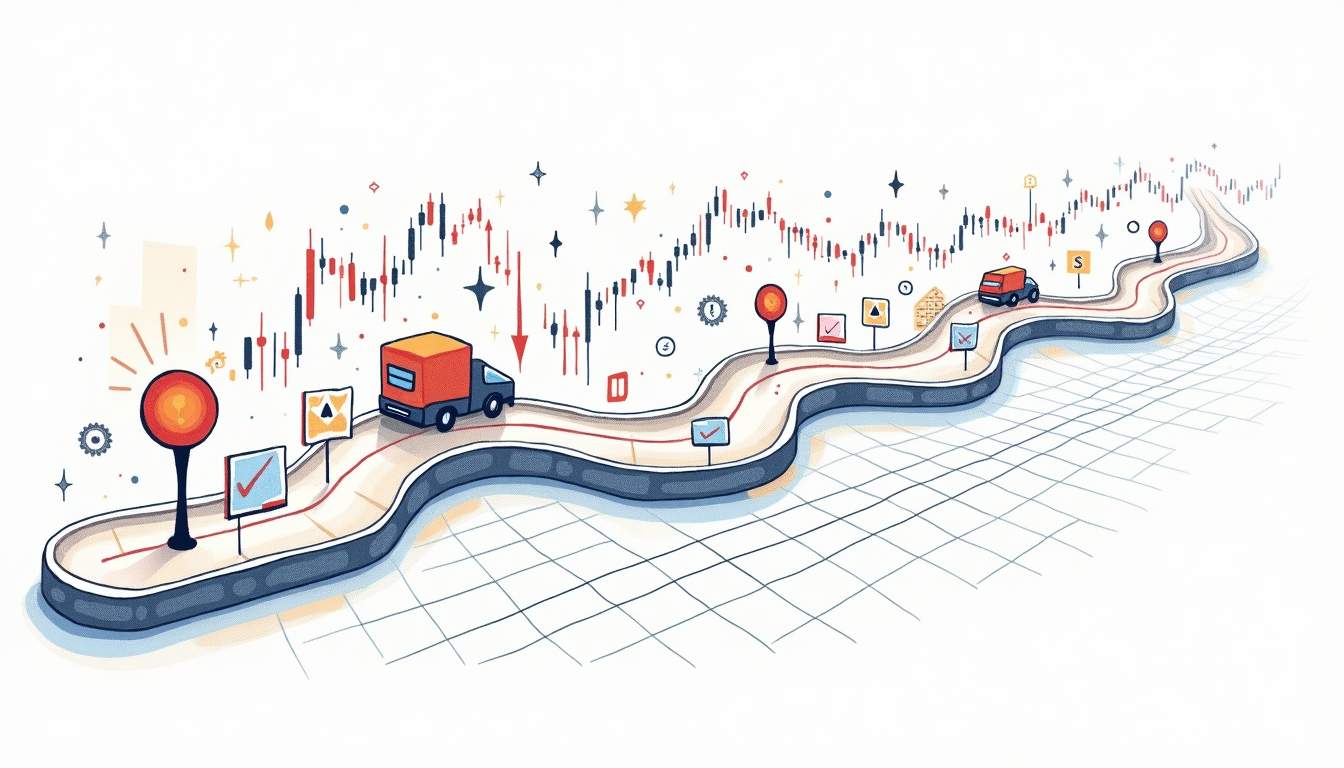
Scaling up involves enhancing data coverage, integrating more sophisticated execution tactics, and expanding governance processes. Each stage should be accompanied by clear success criteria, so resources are allocated to systems that demonstrate real, measurable value.
Final thoughts: disciplined, data-first trading
Data-driven automation does not promise guaranteed profits, but it does offer a disciplined framework for exploiting reproducible edges. Success depends on rigorous data practices, realistic testing, robust execution, and vigilant risk management. Treating automation as an engineering discipline with strong feedback loops enables steady improvements and increases the odds of long-term trading success.

Markets change, and models will fail from time to time. The systems that endure are those that make failures visible early, control downside, and incorporate learning into the next iteration. With a thoughtful approach to data, governance, and operations, automation becomes a multiplier of skill rather than a black-box shortcut.