
Building a Scalable and Resilient Web Application on AWS
Developing a web application is no longer just about launching features quickly; it also requires planning for growth and stability. Applications that are not designed to scale often encounter performance issues and operational challenges as user traffic increases. AWS offers a powerful cloud ecosystem that supports smooth expansion while maintaining reliability and speed. By embedding scalability into the foundation, teams can ensure consistent performance and long-term application success. The AWS Certification Course is designed to equip learners with in-demand cloud skills and prepare them for globally recognized AWS certification exams.
AWS as a Growth-Oriented Cloud
AWS is designed to support applications as they grow from small deployments to large-scale platforms. Its elastic infrastructure dynamically adjusts resources based on real-time demand, ensuring optimal performance without unnecessary overhead. With an extensive range of managed services, AWS reduces infrastructure complexity and simplifies ongoing maintenance. This allows development teams to focus on improving features and user experience rather than managing servers.
Structural Design
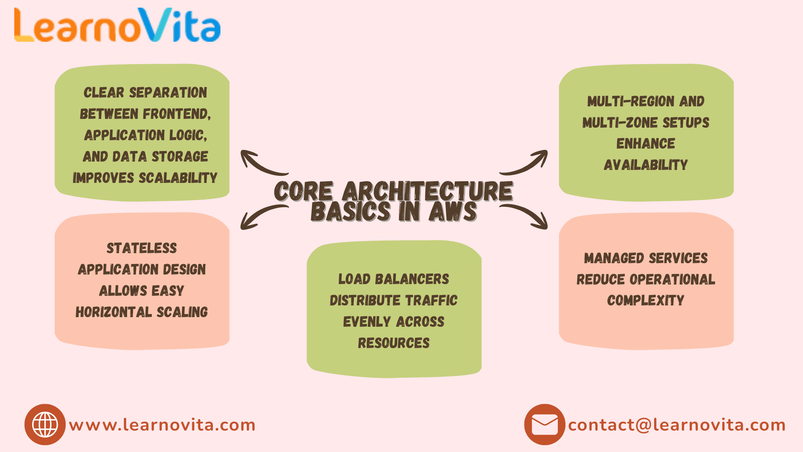
- Clearly separate frontend, backend, and data layers to enable independent scaling
- Design stateless services to support horizontal growth
- Distribute traffic evenly to prevent performance bottlenecks
- Use managed services to minimize operational workload
- Build architectures that remain resilient during failures
Frontend Delivery Model
A scalable frontend emphasizes fast load times, global reach, and high availability. Hosting static assets on cloud storage and delivering them through content delivery networks ensures users experience low latency regardless of location. This approach reduces backend dependency and improves performance during traffic surges. A well-designed frontend also enhances usability and overall application reliability. A Software Training Institute helps individuals learn and improve their technical skills in various software and IT tools.
Backend Adaptation
The backend must efficiently handle requests while remaining flexible under changing workloads. AWS enables backend services to scale automatically through dynamic resource provisioning and intelligent traffic management. Decoupling backend components allows individual services to scale independently as demand increases. This results in improved fault tolerance and consistent performance during peak usage periods.
Data Handling Approach
- Select databases that support elastic scaling and high availability
- Store session and state data outside application servers
- Implement caching to reduce latency and backend load
- Align storage solutions with data access requirements
- Enable replication to improve reliability and uptime
Security and System Visibility
As applications scale, maintaining strong security and operational visibility becomes increasingly important. AWS integrates identity management, encryption, and network protection into its services to safeguard data across all layers. Monitoring and logging tools provide continuous insight into system health and performance. This visibility helps teams detect issues early and optimize resource usage proactively.
Conclusion
Building a scalable and resilient web application on AWS requires careful planning and strategic use of cloud-native services. By focusing on modular architecture, automated scaling, robust security, and continuous monitoring, teams can create applications that grow smoothly with user demand. AWS provides the flexibility and reliability needed to support sustainable growth and long-term success.