
CyberArk Vaults and Safes as the Backbone of IT Access Protection
Privileged credentials are essential for administering enterprise IT systems, yet they also represent one of the most sensitive security elements. These credentials provide elevated access to infrastructure, applications, databases, and automated services, making them a primary target for cyber threats. Many traditional security controls are not designed to protect such high-impact access effectively. CyberArk addresses this challenge through its Privileged Access Management approach, where Vaults and Safes form the foundation of credential security. For IT professionals, understanding these components is critical to maintaining secure and controlled access across the organization. Advance your career in cybersecurity with our CyberArk Online Training, offering expert-led sessions that help you master privileged access management and secure digital identities from anywhere.
CyberArk Vault Concept
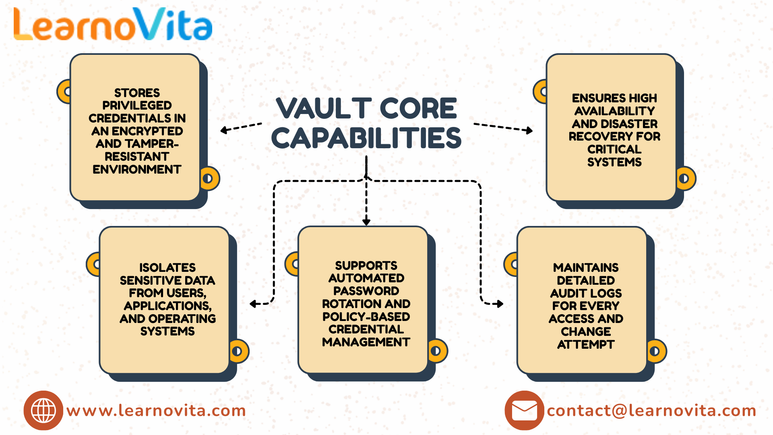
The CyberArk Digital Vault is a dedicated security repository engineered to safeguard privileged credentials. Unlike common password storage solutions, the Vault operates within a highly restricted and isolated environment, significantly reducing its exposure to attacks. All credentials stored in the Vault are protected using strong encryption techniques, ensuring security throughout their lifecycle. Direct access to passwords is completely restricted, even for administrators, helping organizations prevent insider threats and accidental disclosure.
Vault Security Features
- Encrypts privileged credentials using advanced cryptographic standards
- Operates in a hardened and isolated system environment
- Automates password rotation in line with defined security policies
- Captures detailed logs for all credential access and changes
- Supports system continuity through availability and recovery mechanisms
Purpose of CyberArk Safes
CyberArk Safes function as logical containers within the Vault, designed to organize privileged credentials in a structured and manageable way. Rather than storing all credentials together, Safes allow organizations to group access based on applications, environments, or operational ownership. This logical organization improves visibility, simplifies access management, and supports scalable credential governance across complex IT ecosystems. Our Best Training & Placement Program ensures hands-on learning and career support, guiding you from skill-building to securing your dream job.
Permission Management in Safes
Safes provide granular control over how credentials are accessed and managed by users, applications, and automated processes. Permissions can be configured to allow necessary actions, such as secure credential retrieval or controlled password updates, without exposing the actual passwords. This controlled access model supports operational requirements while enforcing least-privilege principles and minimizing the risk of credential misuse.
Safe Design Guidelines
- Structure Safes according to application ownership or environment scope
- Assign only minimal permissions required for operational tasks
- Apply consistent naming conventions to improve clarity
- Enable automated credential rotation to reduce manual effort
- Review audit logs regularly to detect abnormal access behavior
Usage Across Modern IT
CyberArk Vaults and Safes are widely adopted across enterprise, cloud, and DevOps environments to secure privileged access. As organizations move toward cloud platforms and automation-driven workflows, the number of secrets such as service accounts, API keys, and access tokens continues to grow. Safes enable secure, on-demand access to these credentials without embedding them in code or configuration files, supporting modern IT practices while maintaining visibility and control.
Conclusion
CyberArk Vaults and Safes provide a strong and reliable framework for managing privileged access in modern IT environments. The Vault ensures robust credential protection through encryption and isolation, while Safes deliver organized storage and controlled access. Together, they help IT teams enhance security posture, meet compliance requirements, and reduce exposure to credential-based threats. A clear understanding of these components is essential for professionals responsible for protecting critical systems and sensitive access.