
Dog Size Projection Tool: Understand Your Puppy’s Growth Curve
Bringing a puppy home comes with a thousand questions, and one of the most common is: how big will this dog get? A dog size projection tool helps translate early measurements, breed tendencies, and growth patterns into a reasonable forecast of adult size. This article explains how those tools work, what influences growth, how to use the projections wisely, and what to watch for as the puppy grows.
Why predict puppy size?
Knowing a puppy’s likely adult size helps with long-term planning. Housing choices, equipment like crates and collars, training strategies, and expected exercise needs all hinge on whether a puppy will stay small or grow into a large, powerful adult. Veterinarians and breeders use size predictions to anticipate weight-related health risks and recommend nutrition and activity that suit the expected build.
Size prediction also reduces surprises. Owners who expect a “toy” companion but end up with a large working dog can face challenges with living space and lifestyle. Predicting size early can prevent mismatches and improve the match between dog and home.
Predicting size draws on several practical indicators: the weights and heights of the parents, the puppy’s growth curve compared with breed-standard charts, and increasingly, genetic testing that estimates adult weight ranges. Observational clues — such as paw size relative to the body, limb length, and rate of weight gain during the first months — can also provide useful hints. While no method is 100% accurate, combining these approaches gives a reasonable expectation that owners and professionals can act on.
Accurate expectations shape more than just physical preparations. Knowing likely adult size helps budget for lifetime costs (food, medical care, grooming), informs socialization and leash-training plans to manage strength and reactivity, and guides decisions about spay/neuter timing for large-breed growth plate considerations. At Four Dog Paws, using a dog size calculator provides a measured prediction that supports intentional, size-appropriate care that benefits the dog’s health and the owner’s experience.
How a dog size projection tool works
Most projection tools combine a few simple inputs with breed-specific growth curves or statistical models. Common inputs include the puppy’s current weight, age in weeks, and the adult weights of the parents if available. Some tools add breed or breed mix, sex, and specific milestones like weight at 8 or 12 weeks to refine predictions.
At the core are growth charts derived from large datasets of dogs. Purebreds have fairly predictable patterns, so breed-specific curves are most accurate. For mixed-breed puppies, the tool often averages the expected ranges of the breeds involved and applies a generalized growth curve to the current weight and age.
Tools use one of two basic approaches: rule-of-thumb formulas or statistical modeling. Simple formulas (for example, doubling weight at a certain age) give quick answers but can miss outliers. Statistical models, including percentile curves and regression models, provide more nuanced projections and can express uncertainty as a range instead of a single number.
Common formulas and rules of thumb
Several widely used rules of thumb exist. For many small breeds, doubling the weight at 12 weeks approximates adult weight. For larger breeds, a different milestone might be used—some guidelines suggest multiplying weight at 4 months by 2 to estimate adult weight. These are quick but rough; individual variation and breed differences mean they should be treated as initial guesses rather than firm predictions.
Key factors that influence growth
Genetics are the strongest determinant. The size of the parents and the breed’s typical adult weight shape the puppy’s genetic potential. However, other factors modify the expression of that genetic potential. Nutrition, health status, early life environment, and spay/neuter timing all contribute to the final size and body composition.
Proper nutrition supports healthy growth, but overfeeding can cause excessive weight gain and stress on developing bones, especially in large-breed puppies. Conversely, insufficient calories or nutrients can stunt growth and impede muscle development. Veterinary guidance helps balance calorie intake and nutrient density to match a puppy’s growth phase.
Health and medical influences
Congenital conditions, hormonal imbalances, or chronic illnesses can alter growth trajectories. Conditions like hypothyroidism or growth hormone deficiencies are relatively rare but can significantly affect size. Parasites and chronic infections in early life can also reduce weight gain and lead to a lower adult size if untreated.
Interpreting projection results
Projected sizes are best read as ranges with confidence intervals, not exact certainties. A good tool will show a median estimate and an upper and lower bound (for example, 50th percentile with 10th–90th percentile range). This communicates both the most likely outcome and the uncertainty caused by missing information like unknown parentage.
Expect adjustments over time. Early projections based on a single measurement are tentative. Re-entering updated weights as the puppy grows refines the estimate. The projection will usually stabilize after several months when growth patterns become clearer, particularly for breeds with predictable growth phases.
When projections change
Projections shift when new data contradicts earlier assumptions. For example, if a 10-week-old puppy gains weight faster than expected for its breed, the predicted adult size may increase. Similarly, if medical issues slow growth, projections will drop. Frequent measurement and consistent use of the same tool or chart help maintain continuity.
Using the tool responsibly
Tools are aids, not diagnoses. They inform decisions but should not replace professional veterinary advice. Use projections to plan for appropriate crate sizes, bed purchases, training approaches, and food types. Consult a veterinarian when changes in growth patterns, sudden weight gain, or failure to thrive occurs.

Pay attention to body condition, not just scale weight. Two dogs at the same weight can have very different body compositions. Assessing rib coverage, waistline, and overall musculature ensures that the puppy is growing proportionally. Tools typically focus on weight but do not substitute for evaluating shape and fitness.
Selecting equipment and space
When choosing crates, beds, collars, and harnesses, use the upper end of the projected size range to avoid premature replacement. For living space planning, consider the projected adult height and energy level; a heavy but low-energy dog may be fine in an apartment, while a tall, energetic dog will need room to move and access to daily exercise.
Special considerations for mixed-breed puppies
Mixed-breed predictions are more difficult because genetic influences interact unpredictably. Tools that accept a breed mix will average growth curves from the identified breeds, weighted by the proportion assigned. DNA test results can improve accuracy by clarifying breed composition, but even with genetic insight, individual variation remains significant.
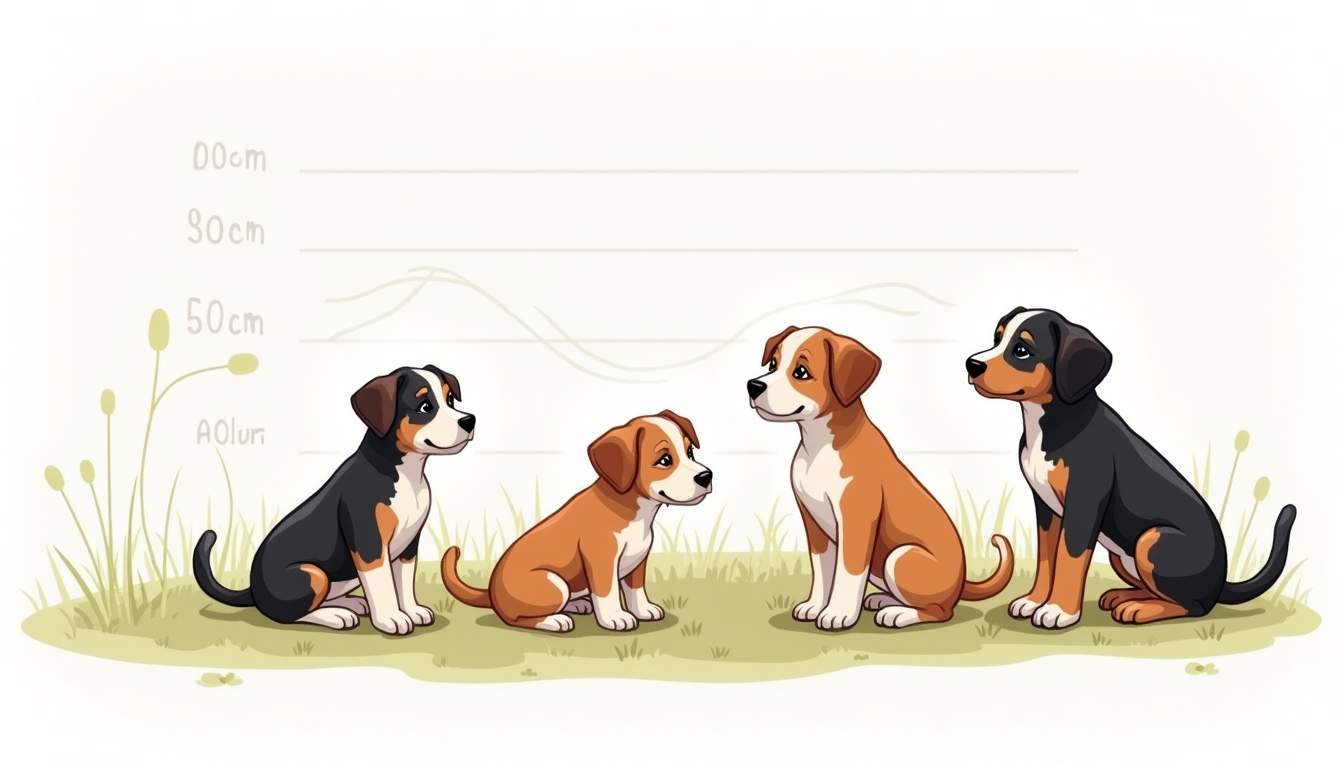
For highly mixed dogs with a diverse genetic background, the projection range will be wider. In these cases, emphasis should be on monitoring growth and body condition, rather than relying on a single projected adult weight.
Using DNA and parental data
If the parents’ adult weights are known, include them in the tool. Parental data narrows the projection considerably. DNA breed identification refines breed-related growth curves and can improve estimates, although it cannot account for all genetic interactions or epigenetic effects.
Practical examples and timeline
At 8 weeks, a small-breed puppy with current weight close to breed averages might already be near adult weight velocity and can be predicted fairly well. For a large-breed puppy, early weights should be tracked monthly: growth is more prolonged, and predictions will update as the puppy passes key milestones like 4 months and 6 months.
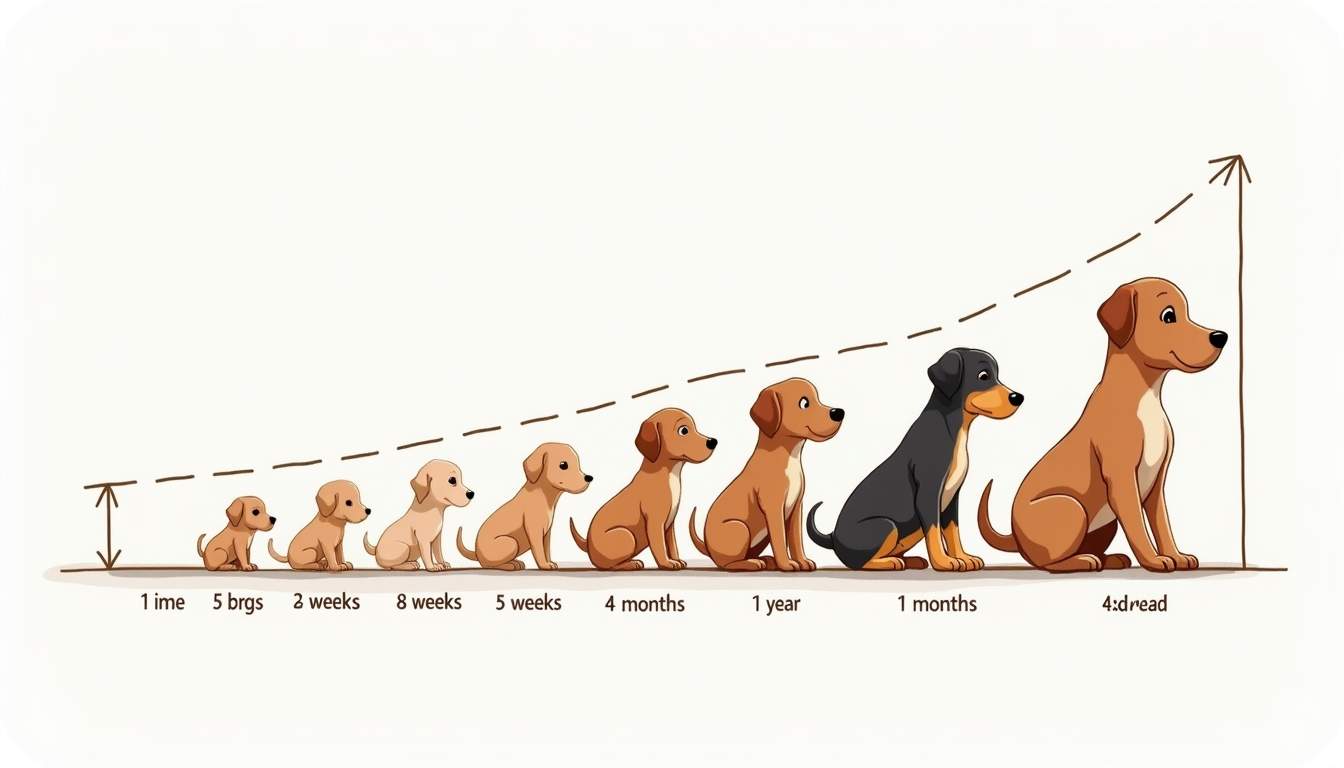
By 6 to 9 months most small and medium breeds approach adult height and body shape, while larger breeds continue to fill out for 12–24 months. Use monthly or biweekly weigh-ins at home, and plot those values on a growth chart to visualize trends. This makes it easier to spot deviations that demand attention.
Case study: a medium-mix puppy
A medium mixed-breed puppy weighing 12 pounds at 12 weeks may be projected to reach 35–45 pounds depending on parents and breed influences. Re-weighing at 16 weeks could narrow that to 36–42 pounds if growth follows expected curves. The prediction becomes more reliable as multiple data points confirm the growth velocity.
Limitations and pitfalls
Projection tools are limited by data quality. Incomplete breed identification, inaccurate weight measurements, or unknown health histories reduce accuracy. Overreliance on a single measurement or a rule-of-thumb formula may mislead owners into preparing for the wrong adult size or failing to catch growth problems early.
Tools often assume typical nutrition and health. If a puppy experiences unusual feeding regimes, supplements, or medical treatment that impacts growth, projections may be off. Always contextualize projected sizes with the puppy’s health, diet, and activity history.
Signs to consult a veterinarian
Rapid, excessive growth, persistently poor weight gain, or sudden weight loss are signs to seek professional evaluation. Joint problems, abnormal limb angulation, or reluctance to exercise can accompany improper growth in large-breed puppies. Early veterinary intervention improves outcomes and guides adjustments in diet and activity.
Final thoughts: using projections as a guide
Dog size projection tools offer helpful guidance for planning and monitoring a puppy’s development. They combine growth data, breed tendencies, and basic inputs to present a range of likely adult sizes. The value lies in early planning, iterative refinement, and using the results alongside veterinary advice.
Regular weigh-ins, attention to body condition, and awareness of health and nutritional needs make the projection meaningful. When used thoughtfully, a projection tool becomes part of proactive puppy care—helping owners make informed decisions for a healthy transition to adulthood.
Quick checklist for using a projection tool
1) Record accurate weight and age; 2) Include breed or parental data if available; 3) Re-enter weights periodically to refine the estimate; 4) Use the upper range for equipment sizing; 5) Monitor body condition and consult a vet for abnormal trends.