
How AI and Automation Are Shaping the Future of UI/UX Design
Artificial intelligence and automation are bringing a powerful transformation to the world of UI/UX design, reshaping how digital experiences are imagined and developed. Instead of depending entirely on manual research, long design cycles, and repetitive tasks, designers now work alongside intelligent systems that streamline processes and uncover insights instantly. This new partnership enhances creativity by reducing operational workload and enabling faster decision-making. As these technologies mature, design teams gain tools that support deeper empathy, sharper precision, and more personalized experiences. The shift signals a future where human creativity and machine intelligence complement one another seamlessly. Advance your design career from anywhere with our UI/UX Design Online Course, where you’ll learn to craft engaging user experiences and intuitive interfaces through interactive sessions, expert mentorship, and hands-on projects.
Smarter User Insights
AI’s ability to interpret large volumes of user data introduces a new depth to understanding audience behavior. Designers can now see detailed patterns related to engagement, navigation choices, frustrations, and emotional responses—all in a fraction of the time traditional methods required. These insights help identify what users truly need, rather than what teams assume they want. With more accurate information, designers can build experiences that feel intuitive from the very first interaction. This data-backed approach reduces uncertainty and supports more strategic, user-centered decision-making throughout the design process.
Automated Design Tasks
Automation has become a valuable ally in eliminating repetitive work, such as resizing elements, preparing screen variations, and handling design consistency. With these tasks executed instantly by intelligent tools, designers experience fewer errors and spend less time on routine adjustments. This shift allows them to devote more energy to exploration, storytelling, and conceptual development. As design workflows become more efficient, teams can deliver high-quality results much faster. Automation ultimately brings ease and speed into the creative process without compromising the designer’s vision or attention to detail.
Adaptive Personalization
AI-driven personalization is enabling digital products to respond to each user in more engaging and context-aware ways. Interfaces can now adapt content, layouts, and interactions based on individual habits, preferences, and behavioral patterns. This creates experiences that feel relevant, comfortable, and closely aligned with what users naturally expect. Personalization improves satisfaction while reducing cognitive load, helping users reach their goals effortlessly. As AI continues to learn from ongoing interactions, the experience becomes more refined, transforming interfaces into living systems that grow alongside their users. Our Best Training & Placement Program is designed to equip learners with practical skills and provide strong career support to secure opportunities in leading companies.
AI in Creative Ideation
Generative AI introduces new creative possibilities by offering instant design alternatives and fresh visual directions. With simple prompts, designers can explore multiple styles, themes, or layout variations that spark inspiration and broaden their artistic perspectives. These suggestions serve as a starting point rather than a final solution, guiding designers toward ideas they may not have considered on their own. This energizes the brainstorming phase and encourages more experimental and imaginative thinking. With AI acting as a creative partner, ideation becomes faster, more dynamic, and richer in possibility.
Workflow Efficiency Boost
AI-based tools simplify the prototyping and testing process by automating much of the initial validation work. Designers can quickly generate interactive models, simulate user actions, and identify potential issues before development begins. This reduces the number of iterations needed later in the process and helps teams gain clarity earlier. With smoother workflows and fewer obstacles, designers can focus more on refinement and innovation. Overall, AI brings speed, accuracy, and confidence to the entire design journey, strengthening outcomes at every stage.
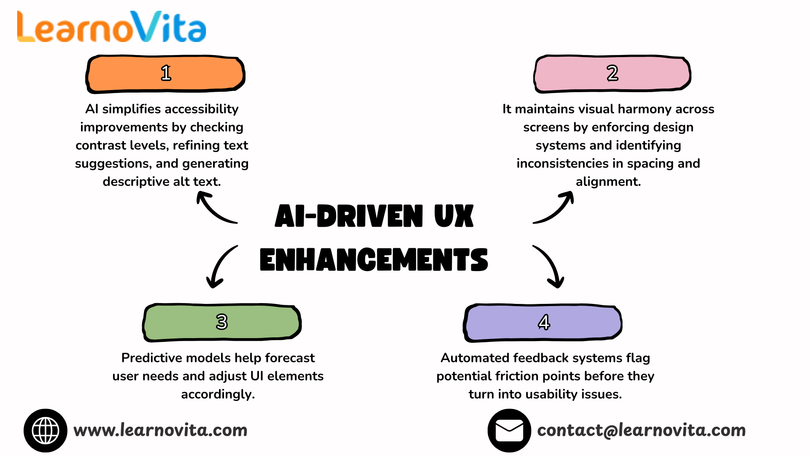
AI-Driven UX Enhancements
- Helps improve accessibility by suggesting readable text contrast, generating meaningful descriptions, and highlighting areas that may affect usability.
- Maintains visual harmony by identifying alignment concerns, adjusting spacing, and supporting consistent design principles across screens.
- These enhancements make interfaces more inclusive, visually balanced, and user-friendly, strengthening the overall experience.
Automation Advantages for Designers
- Shortens the time required for routine tasks, giving designers greater freedom to explore concepts and craft thoughtful solutions.
- Accelerates design cycles, enabling teams to iterate quickly and deliver refined experiences with improved precision.
- These benefits support a more creative and productive workflow, allowing designers to focus on imaginative work instead of repetitive duties.
Conclusion
AI and automation are becoming essential elements of the modern UI/UX ecosystem, shaping a more efficient and user-centered approach to design. Even as intelligent tools enhance accuracy and speed, the human role remains at the heart of meaningful digital experiences. Designers bring empathy, intuition, and emotional understanding—qualities that technology cannot replace. When human creativity merges with AI-driven power, the result is a design process that is smarter, more adaptive, and deeply aligned with user needs. This synergy marks the next era of UI/UX, where innovation thrives through collaboration between people and intelligent systems.