
How Residential Spray Foam Cuts Monthly Utility Bills
Residential spray foam insulation cuts monthly utility bills by creating a nearly perfect, high-performance building envelope that dramatically reduces a home’s overall energy consumption. It achieves this by attacking the two primary ways a home wastes energy: heat transfer and air leakage. With its high R-value, it effectively stops heat from moving through the structure, and as a complete air barrier, it stops the drafts and leaks that force an HVAC system to run constantly. By creating a home that is exceptionally good at maintaining its own temperature, Residential spray foam expert allows the heating and cooling system to run far less often, which leads to massive energy savings and a significant drop in monthly utility bills.
Understanding the science behind this dramatic energy reduction reveals the specific ways a professional spray foam installation can impact a homeowner’s budget. The information is based on the practical, hands-on experience of building performance experts who know that the cheapest and greenest energy is the energy you never have to use.
The Two Main Reasons Your Energy Bills Are So High
To understand how spray foam saves money, it is important to first understand the two main ways a home loses the energy it has paid for.
1. Heat Transfer
Heat is always trying to move from a warmer place to a cooler one. In the winter, the expensive heat your furnace creates is constantly trying to escape through your walls and ceiling. In the summer, the intense outdoor heat is relentlessly pushing its way into your cool, air-conditioned home. An insulation’s ability to fight this movement is measured by its R-value. A low R-value means the HVAC system has to work very hard just to keep up with this constant heat flow.

2. Air Leakage
An even bigger problem in most homes is air leakage. The average house has enough hidden gaps and cracks to be equivalent to leaving a window open 24/7. This means your HVAC system is not just conditioning your home; it is trying to condition a constant, incoming stream of outside air. In a hot, humid climate, this means it is fighting a huge load of incoming heat and humidity. This is an impossible task that forces the system to run almost continuously, which is the primary cause of high energy bills and premature equipment failure.
How Spray Foam Creates a High-Performance Home
Spray foam is unique in that it provides a complete, all-in-one solution to both of these problems.
Superior Thermal Resistance
Spray foam, particularly the closed-cell variety, has one of the highest R-values of any commonly used insulation material, typically around R-7 per inch. This high thermal resistance is extremely effective at slowing down the transfer of heat, providing a powerful first line of defense for your HVAC system.
The Power of a Perfect Air Seal
This is the feature that truly transforms a home’s performance. Spray foam is applied as a liquid and expands to fill every crack, seam, and void, adhering directly to the building materials. This creates a solid, seamless, and permanent air barrier. It stops the uncontrolled flow of air completely.
By creating this airtight seal, the home’s “heating and cooling load” is drastically reduced. The HVAC system is no longer fighting a constant battle against the outdoors. It can now easily and quickly bring the home to the desired temperature and then shut off for long periods. This is the key to massive energy savings.
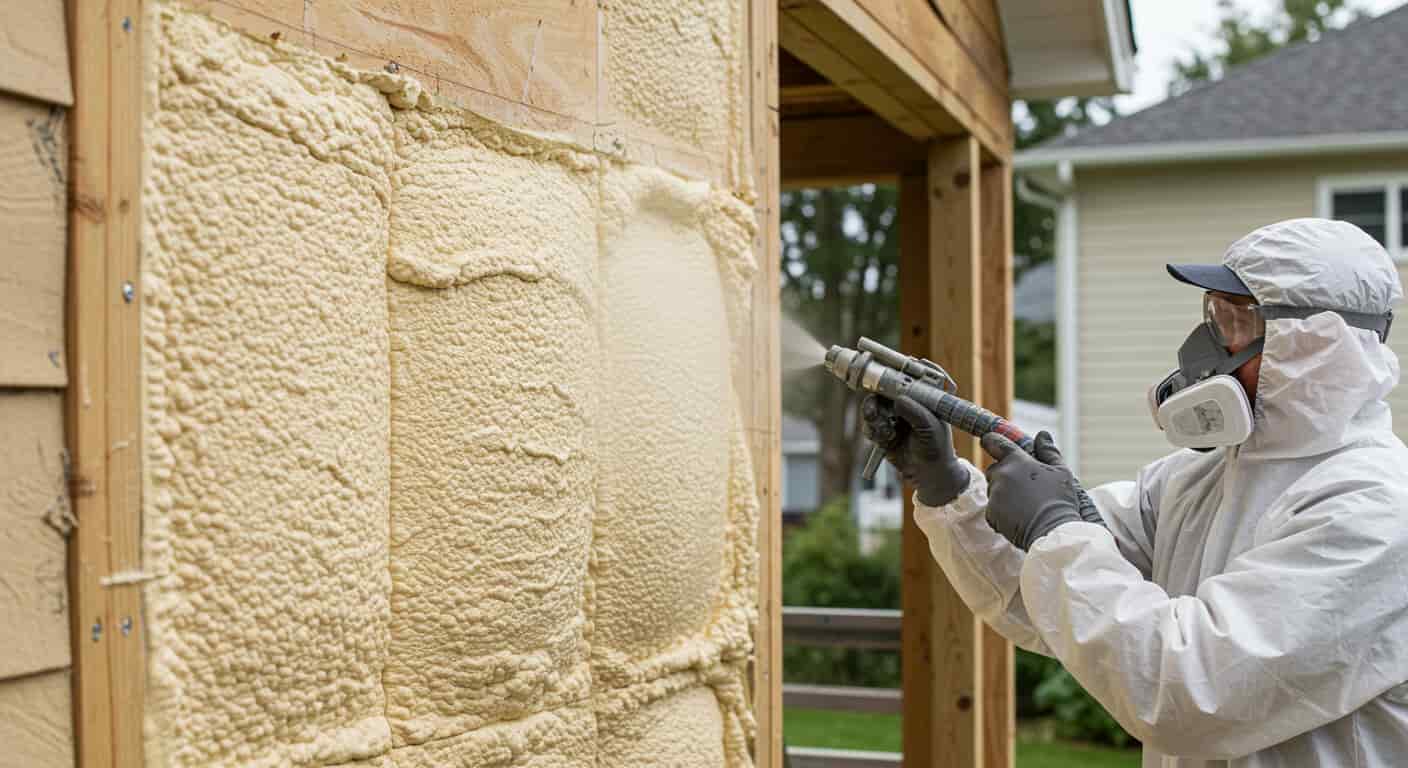
Here is a comparison of how spray foam impacts HVAC operation:
|
HVAC Performance Factor |
Standard Home (Fiberglass) |
High-Performance Home (Spray Foam) |
|---|---|---|
|
Typical Run Time |
Long, frequent cycles, especially on very hot or cold days. |
Short, infrequent cycles, even in extreme weather. |
|
Daily Energy Consumption |
High |
30-50% Lower |
|
Ability to Maintain Temperature |
Struggles to keep up; temperature may fluctuate. |
Holds a stable, consistent temperature with ease. |
|
Strain on Mechanical Parts |
Very high due to constant operation. |
Very low due to reduced workload. |
|
Resulting Equipment Lifespan |
Can be significantly shortened. |
Can be significantly extended. |
These performance improvements lead to significant long-term financial advantages that go beyond the monthly utility bill.
The Broader Financial Benefits of an Efficient Home
The advantages of a high-performance home go beyond just the monthly energy savings.
A Longer Lifespan for Your Most Expensive Appliance
Your HVAC system is one of the most expensive and complex pieces of equipment in your home. By drastically reducing its workload, you are also drastically reducing the wear and tear on its most important components, like the compressor and the fan motor. An HVAC system in a high-performance home can last years longer than one in a standard, leaky home, saving you thousands of dollars in premature replacement costs.
A Higher Return on Investment
An insulation upgrade is consistently ranked as one of the home improvement projects with the highest return on investment. According to Remodeling Magazine’s annual Cost vs. Value report, an attic insulation upgrade is one of the few projects that can return over 100% of its cost at resale. A home with a high-performance envelope and a documented history of low utility bills is a more valuable and attractive asset on the real estate market.
Bonus Tip: The rim joist, the wooden perimeter that sits on top of a home’s foundation in a basement or crawl space, is a major source of air leakage in a cold climate. Sealing this small area with a few inches of closed-cell spray foam is a very cost-effective way to make a big impact on both your energy bills and your comfort.
Things to Consider Before Your Project
- A Professional Energy Audit is the Best First Step: A certified home energy auditor can use tools like a blower door to measure exactly how leaky your home is and an infrared camera to visually pinpoint the biggest areas of heat loss. This data-driven approach ensures you are investing your money where it will have the most significant impact.
- Prioritize the High-Impact Areas: For most homes, the attic is the most cost-effective place to start. This is where you can achieve the biggest reduction in your home’s heating and cooling load for your investment. After the attic, the next priority is the basement or crawl space.
- This is Not a DIY Project: Spray foam is a complex chemical product that is manufactured on-site. It requires extensive training, specialized equipment, and strict safety protocols to install correctly.
Final Thoughts on a Smarter Home
High energy bills do not have to be a fact of life. They are a direct result of a home that is not equipped to handle the local climate. By investing in a proper, professional spray foam insulation system, homeowners can create a high-performance home that is easy and affordable to heat and cool. It is an investment that starts paying you back on the very next utility bill and continues to do so for as long as you own your home, all while making your living space more comfortable and healthier.
Get a Professional Energy Savings Assessment
If you are ready to stop overpaying to heat and cool your home, the first step is a professional evaluation of your current insulation. An experienced contractor can identify the weak spots in your home’s thermal defense and create a customized plan to fix them. For homeowners looking for an expert opinion, the team at Premier Insulation has deep expertise in designing insulation systems for all types of homes. They can be reached for a consultation by email at [email protected] or by phone at (229) 554-3939.
Reviewer: Jack Parker, a spray foam professional with 7 years of experience, reviewed this post and helped improve sections dealing with brand clarity and customer communication.