
Precision CNC Machining: The Engineering Backbone of High-Performance Industries
Titanium occupies a unique position in the world of precision manufacturing. It is strong yet lightweight. It resists corrosion in environments that would degrade most metals. It is biocompatible, making it the material of choice for medical implants. Yet for all its advantages, titanium is notoriously difficult to machine. The shops that have mastered this material are not just suppliers—they are strategic partners enabling innovation across aerospace, medical, automotive, and defense sectors.
Why Titanium Is Both Essential and Demanding
Titanium’s remarkable strength-to-weight ratio—approximately 40 percent lighter than steel with comparable strength—makes it indispensable for applications where weight reduction is critical. Its corrosion resistance and biocompatibility make it the standard for surgical implants and medical devices. But these same properties create significant machining challenges.
Titanium has poor thermal conductivity. Heat generated during cutting stays concentrated at the tool edge rather than dissipating through the workpiece. This accelerates tool wear and can cause the material to weld itself to the cutting tool—a phenomenon known as galling. Titanium also work-hardens rapidly. If cutting parameters are not precisely optimized, the material hardens ahead of the cut, making subsequent passes even more difficult.
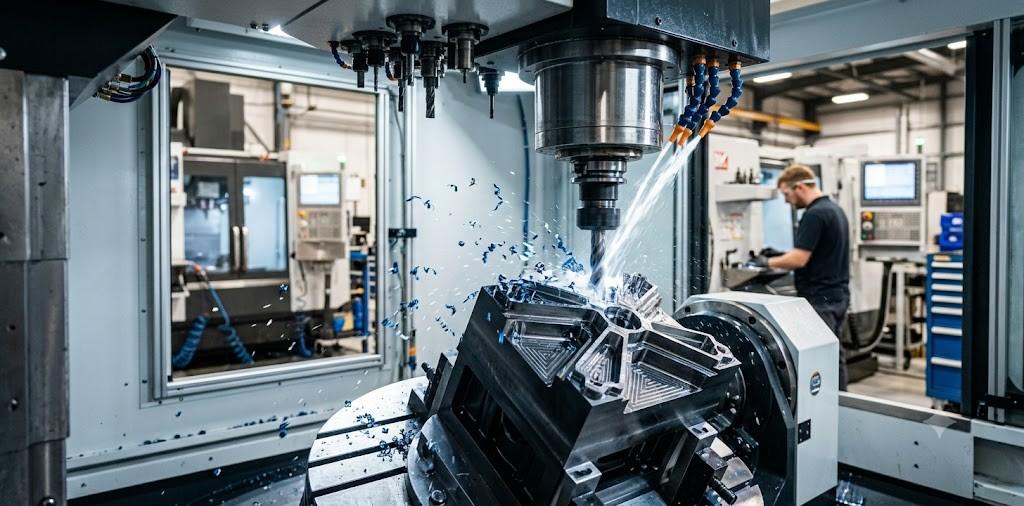
Experienced shops treat titanium with respect. They understand that successful titanium machining is not about brute force—it is about control: the right tool geometry, the right cutting parameters, the right coolant delivery, and the right machine rigidity. High-pressure coolant systems—often operating at 1000 PSI or more—are essential to prevent work hardening and flush chips away from the cutting zone.
Industries Driving Titanium Demand
Aerospace remains the largest consumer of titanium components. Aircraft structural parts, engine components, and fasteners all rely on titanium alloys for their strength-to-weight ratio and thermal stability. High-temperature titanium alloys are seeing particularly strong growth as engine operating temperatures increase.
The medical sector represents another critical growth area. Titanium’s biocompatibility makes it the material of choice for surgical implants, orthopedic screws, pins, rods, and dental devices. These components must be machined with surface finishes that promote osseointegration and tolerances that ensure proper fit. Surface finishes to Ra 0.8 μm are standard, with 100 percent dimensional inspection and traceability required for every batch.
The fasteners market tells a similar story. Titanium bolts, nuts, and screws are increasingly specified in applications where weight reduction and corrosion resistance are critical—aerospace airframes, medical implants, automotive racing components, offshore equipment, and even bicycle and motorcycle components. A typical titanium fastener is approximately 40 percent lighter than steel while maintaining comparable strength. This weight saving translates directly to fuel efficiency in aerospace, better performance in racing applications, and reduced fatigue in medical devices.
The Swiss Machining Advantage for Titanium
Among precision machining processes, Swiss-type turning has become the preferred technology for titanium components. Originally developed for watchmaking, Swiss machines feed material through a guide bushing positioned immediately next to the cutting tool. This design eliminates deflection and vibration, making it possible to hold tolerances that would otherwise be impossible on long, slender parts.
For titanium, this mechanical stability is essential. The material’s high cutting forces demand rigid setups. Any flexibility in the machine or workholding introduces vibration that degrades surface finish and accelerates tool wear. Swiss machines, with their guide bushing support and multi-axis capability, provide the rigidity that titanium demands.
Modern Swiss machining centers integrate turning, milling, drilling, and threading in a single setup—often on machines with five to nine axes. This “done-in-one” approach reduces handling errors, shortens production cycles, and ensures that critical features stay aligned. For titanium components—whether aerospace fasteners, medical implants, or custom parts—this integration is not a luxury. It is a requirement for achieving the tolerances and surface finishes that these applications demand.
Custom Titanium Components: The Engineering Challenge
Custom titanium machining presents its own set of challenges. Each component is unique, with specific geometry, tolerance requirements, and material specifications. Unlike high-volume production where processes can be optimized over time, custom work demands that every job be set up and proven quickly.
The geometry of custom titanium parts adds another layer of complexity. Components frequently feature thin walls, deep cavities, or intricate internal features. These geometries push the limits of standard tooling and demand specialized approaches. Thin walls are prone to chatter and deflection. Deep cavities require extended tooling with reduced rigidity. Internal features may necessitate custom ground tools or specialized machining strategies.
Material variations compound these challenges. Different titanium grades—from commercially pure titanium to high-strength alloys like Ti-6Al-4V—respond differently to cutting forces. Alpha-beta alloys like Ti-6Al-4V are the most commonly specified, but they present a narrow machining window. Slight deviations in cutting parameters can lead to rapid tool wear or surface damage. Medical-grade titanium (Grade 23 ELI) requires even tighter controls for implantable applications.
For engineers and procurement professionals, this complexity demands a partner with documented experience across titanium grades and part types. That is why many teams turn to a specialist in custom titanium precision machining when their designs push beyond conventional manufacturing capabilities.
Titanium Fasteners: Small Components, Critical Performance
Titanium fasteners represent a particularly demanding category of precision machining. Bolts, nuts, and screws must meet exacting thread standards, maintain consistent mechanical properties, and often undergo specialized surface treatments. A single defective fastener in an aerospace assembly can compromise structural integrity. In medical applications, fasteners must perform reliably in the human body for years or decades.
The geometry of titanium fasteners amplifies the machining challenges. Thread rolling requires precise blank diameters. Head geometries demand complex tool paths. Surface finishes must be controlled to prevent galling during assembly—a particular concern with titanium, which is prone to seizing when threaded components are assembled without proper surface treatment.
Specialized shops approach titanium fasteners with documented processes for each fastener type. In-house thread rolling and CNC turning ensure consistent thread class fit (typically 6g/6H). Anti-seize coatings are available upon request to prevent galling during assembly. Burr-free threads and mirror finishes on bolt heads and screw surfaces are standard requirements.
A provider of precision titanium bolts and nuts brings this specialized knowledge to every order, understanding that these small components carry outsized responsibility in the assemblies they join.
The Role of Process Documentation
In titanium machining, documentation is not optional. Every successful job produces learnings that should be captured and applied to future work. Tool selection, cutting parameters, coolant delivery methods, inspection protocols—all of these should be documented and refined over time.
This institutional knowledge is what separates shops that consistently deliver quality from those that treat every job as a new experiment. For customers, documented processes translate into predictable outcomes. Lead times become reliable. Quality becomes consistent. Scrap rates remain low.
Looking Ahead
The titanium machining market will continue to grow as aerospace, medical, and industrial applications demand the material’s unique properties. As components become more complex and tolerances tighten, the value of specialized process knowledge will only increase. The shops that have invested in Swiss-type turning, documented tooling strategies, and skilled workforces will capture the most demanding programs.
For manufacturers, the question is not whether to source titanium components—it is who to trust with the work. The right partner brings not just equipment but decades of accumulated knowledge about how titanium behaves under cutting forces. That knowledge translates directly to consistency, reliability, and peace of mind.