
Salt Is Not a Substitute for Drainage: The Winter Fix That Starts Before the Spreader Arrives
Coastal winter-service planning for Richmond properties
Salt can help manage ice, but it cannot solve the reason water keeps returning to the same surface.
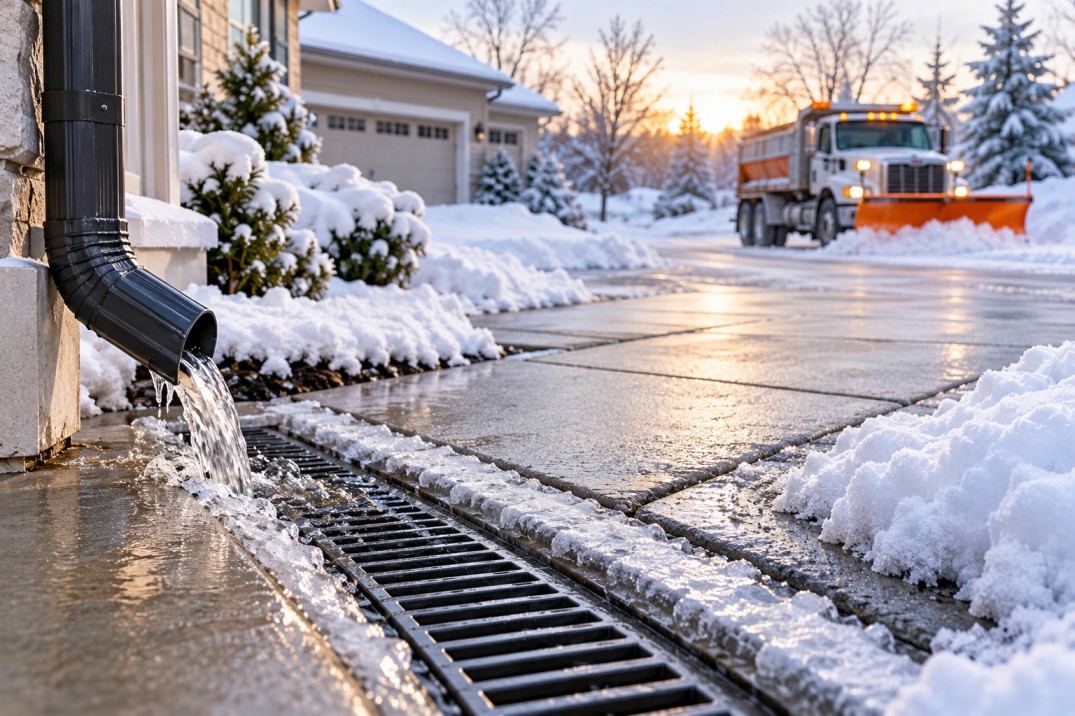
That distinction is central to winter drainage and de-icing. When meltwater, rainfall, roof runoff, or blocked drainage repeatedly feeds a walkway or driveway, applying more material may temporarily improve conditions without correcting the underlying cycle.
The pattern is familiar on coastal strata properties. Precipitation arrives as rain, wet snow, or a mixture of both. Temperatures hover around freezing. Water moves across pavement during the afternoon, then colder overnight conditions turn the same wet area into ice.
If a catch basin is covered by leaves or pushed snow, or if a snow pile releases meltwater directly toward a pedestrian route, the problem can repeat for days.
Good winter management therefore asks two questions: Where is the ice forming, and where is the water coming from?
Treating only the first question can turn de-icing into an expensive loop.
Winter service planning for UBC strata properties
Properties near large campuses and dense residential environments have another layer of complexity. Pedestrian traffic is heavier, routes are interconnected, and a single drainage problem can affect entrances, walkways, stairs, internal roads, and shared access points.
Effective campus-edge strata winter access control depends on identifying which routes need to remain usable first—and what keeps making them wet.
A walkway may be cleared perfectly but receive runoff from higher pavement. A parkade ramp can remain vulnerable because water enters from an exposed driveway. Snow stored beside a path may melt during the day and drain directly across a high-traffic pedestrian connection.
In each case, salt is acting downstream of the actual problem.
That does not make de-icing unnecessary. It makes drainage part of the same winter system.
When service planning combines priority-route knowledge with drainage awareness, crews can treat the surface while also reducing the source of repeated refreeze.
Stop Treating the Same Ice Twice
A recurring icy patch is information.
If the same section needs treatment after every mild winter event, the property should not assume that weather alone is responsible. The site may be telling you that water is being routed incorrectly.
Follow the Water Before Adding More Material
A useful winter inspection starts above the problem area.
Look for snow piles, roof downspouts, landscaped slopes, blocked catch basins, curb channels, drains, and pavement grades. Then follow the likely path of meltwater.
If water crosses a pedestrian or vehicle route before reaching drainage, crews may be treating the symptom repeatedly.
Clearing a drain, cutting a path through accumulated snow, or relocating a snow pile can sometimes reduce the next ice event more effectively than increasing salt application.
Watch What Happens After the Storm
Drainage issues often become most visible after precipitation ends.
Snow begins melting. Rainwater continues moving through the site. Daytime temperatures rise slightly, allowing moisture to travel farther across pavement.
Then evening cooling begins.
The surfaces that remain wet longest are often the ones most likely to refreeze first. That makes post-storm observation particularly valuable for building a better property-specific plan.
Drainage Mapping for Shared Properties
Strata sites should be mapped according to water movement, not only according to snow-clearing zones.
That means identifying catch basins, trench drains, curb channels, downspouts, low points, sloped walkways, garage entrances, stairs, snow-storage locations, and areas where water crosses normal traffic routes.
A simple preseason map can give crews useful context before visibility deteriorates during a storm.
It also helps prevent snow placement from creating new drainage problems.
A pile located directly over a catch basin can restrict drainage precisely when melting begins. A pile placed uphill from an entrance can create several days of runoff. Snow stored beside a narrow walkway may gradually shrink the usable path while also sending water across it.
Only Strata Snow Removal approaches this planning through a strata-only operating model. Because the properties share many recurring challenges—internal roads, parkade ramps, walkways, parking constraints, drainage points, and multiple user groups—site-specific details can become part of service planning rather than being treated as isolated surprises.
GPS and photo service logs can also help document which areas repeatedly require attention.
More Salt Cannot Fix a Bad Water Path
Salt has a legitimate role in winter maintenance. The mistake is asking it to perform work that belongs to drainage.
When salt lowers the freezing point of water, it can help loosen or prevent ice under suitable conditions. But that treated moisture still needs somewhere to go.
If the surface remains wet and receives additional runoff, the treatment cycle continues.
This is where material readiness and material discipline need to work together.
Only Strata Snow Removal maintains substantial salt reserves so that crews are not caught short during extended freeze-thaw periods. But having material available does not mean every problem should be solved by spreading more of it.
Targeted application, drainage correction, mechanical clearing, and follow-up inspection should support one another.
Strict capacity limits and proactive dispatch are also relevant because refreeze events can generate widespread service demand without producing a dramatic snowfall. Many properties may require targeted attention at approximately the same time.
Reliable winter response depends on having enough operational capacity to return when conditions change.
Break the Melt-and-Refreeze Loop
The most effective winter plan is not necessarily the one that uses the most salt. It is the one that prevents the same water from becoming the same ice over and over again.
Property managers can begin by identifying persistent trouble spots.
Where does water collect after rain? Which catch basins become buried during plowing? Where do snow piles drain? Which walkway stays wet after surrounding pavement dries? Does roof runoff reach a pedestrian route? Does a parkade entrance sit below surrounding surfaces?
Those observations turn reactive de-icing into preventive planning.
They also improve communication between the property manager and contractor. Instead of reporting that “the sidewalk is icy again,” the property can identify a recurring runoff path or drainage restriction that deserves specific attention.
Only Strata Snow Removal supports that process with proactive dispatch, GPS and photo documentation, large material reserves, and property-specific winter response. Its damage repair guarantee and cancellation flexibility address additional concerns around the service relationship, while strict capacity management supports consistency during difficult conditions.
The larger principle is simple.
Salt works on ice. Drainage works on water.
A complete winter strategy needs both.
If water has nowhere useful to go, every thaw can rebuild the hazard that was treated the night before. That wastes material, creates repeated service calls, and leaves property managers reacting to the same problem instead of removing its cause.
The strongest winter plan starts before the spreader arrives: understand where the water comes from, keep its path open, place snow with future melt in mind, and use de-icing material where it can actually do its job.
Because once drainage fails, salt is no longer solving the whole problem. It is buying time until the water freezes again.