
The Transformative Role of Generative AI in Modern Technology
Generative Artificial Intelligence has quickly become a key driver of innovation in today’s technological landscape. Unlike traditional AI, which focuses mainly on automation or data analysis, generative AI empowers machines to create original outputs such as text, visuals, software code, and digital experiences. This ability is changing how technology solutions are conceived, developed, and deployed. As businesses and organizations increasingly embrace digital transformation, generative AI is emerging as a critical tool for efficiency, creativity, and growth. Unlock the power of AI by enrolling in our Artificial Intelligence Online Course designed for beginners and professionals alike.
Generative AI Overview
Generative AI refers to advanced AI models that learn from large datasets to generate new and meaningful content. These systems utilize powerful neural networks and transformer-based architectures capable of understanding context, language, and patterns. Their versatility allows a single model to handle multiple tasks across different domains. This adaptability makes generative AI a practical solution for diverse technological and business applications.
Supporting Technologies
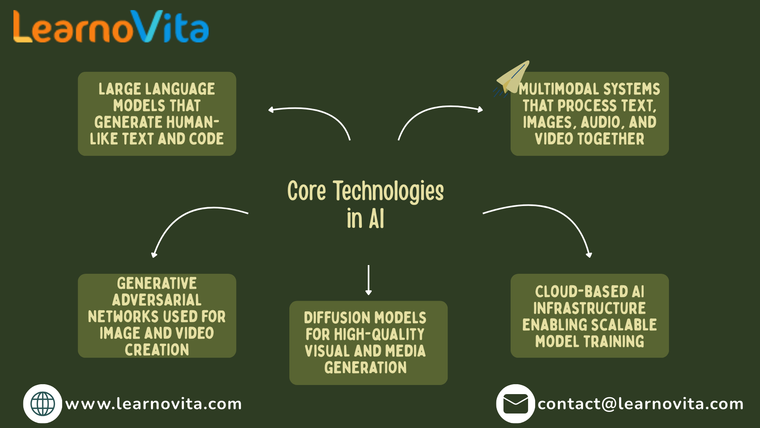
- Large language models that produce natural, context-aware text
- Image and media generation systems creating realistic visuals
- Cloud computing platforms supporting scalable AI training and deployment
- Multimodal AI frameworks combining text, audio, and visual inputs
- Continuous learning mechanisms that improve output accuracy over time
- High-performance hardware accelerating AI processing
Software Development Impact
Generative AI is transforming software development by automating repetitive tasks and simplifying workflows. Developers increasingly use AI tools to generate code, improve logic, and enhance documentation, resulting in faster and more consistent development cycles. This also reduces human errors and enhances maintainability. Consequently, development teams can dedicate more time to innovation, architecture design, and addressing complex technical challenges. Our Best Training & Placement Program ensures hands-on learning and career support, guiding you from skill-building to securing your dream job.
Business and Data Influence
In business and data-driven environments, generative AI is redefining how insights are generated and shared. By translating complex datasets into understandable summaries, it allows stakeholders to interact with data using natural language. This improves accessibility to analytics for non-technical users. Organizations gain faster insights, better forecasting, and stronger alignment between data analysis and strategic decisions.
Key Advantages
- Accelerated creation of digital content and technical resources
- Increased productivity across development and business operations
- Easier access to insights for non-technical users
- Enhanced personalization of digital products and services
- Scalable innovation with optimized use of resources
- Strengthened collaboration between humans and AI systems
Ethical Challenges
The adoption of generative AI also brings ethical and governance considerations that must be addressed. Concerns regarding data privacy, bias, intellectual property, and content authenticity are increasingly significant. Without proper safeguards, these risks can affect trust and compliance. Organizations must implement responsible AI practices and governance policies to ensure ethical and transparent use.
Conclusion
Generative AI is revolutionizing the technology landscape by enabling systems that can create, adapt, and collaborate intelligently. Its influence spans software development, analytics, and business operations, making it an essential component of modern digital transformation. Organizations that adopt generative AI responsibly will be better positioned to drive innovation, enhance efficiency, and maintain a competitive advantage in the evolving AI-driven world.